About Me

I'm a fourth-year Ph.D. student in the Computer Science Department of the University of Illinois at Urbana-Champaign, advised by Professor Matthew Caesar. My full CV can be found here.

I'm interested in networked systems, currently focusing on improving the performance of wide-area and datacenter networks.

In the past, I explored two broad directions - a) understanding how would traffic engineering and congestion control systems would need to be redesigned for satellite networking (in collaboration with Professor Deepak Vasisht), and b) applying the concept of metaverse to enhance IoT pedagogy and debugging.

With my passion for building resilient and secure large-scale software systems, together with Prof. Caesar, I am leading development of a teaching and research platform for virtualizing cyber environments.

Recent News

  • 2026.10: INSITE got accepted to HotNets '26.
  • 2025.09: StarNet got accepted to CoNEXT '25.
  • 2025.05: Network R&D intern at Bytedance.
  • 2025.04: Passed qualifying exam.
  • 2024.10: ThingVisor got accepted to SIGCOMM CCR '24'.
  • 2023.08: Started my Ph.D. at UIUC.

Publications

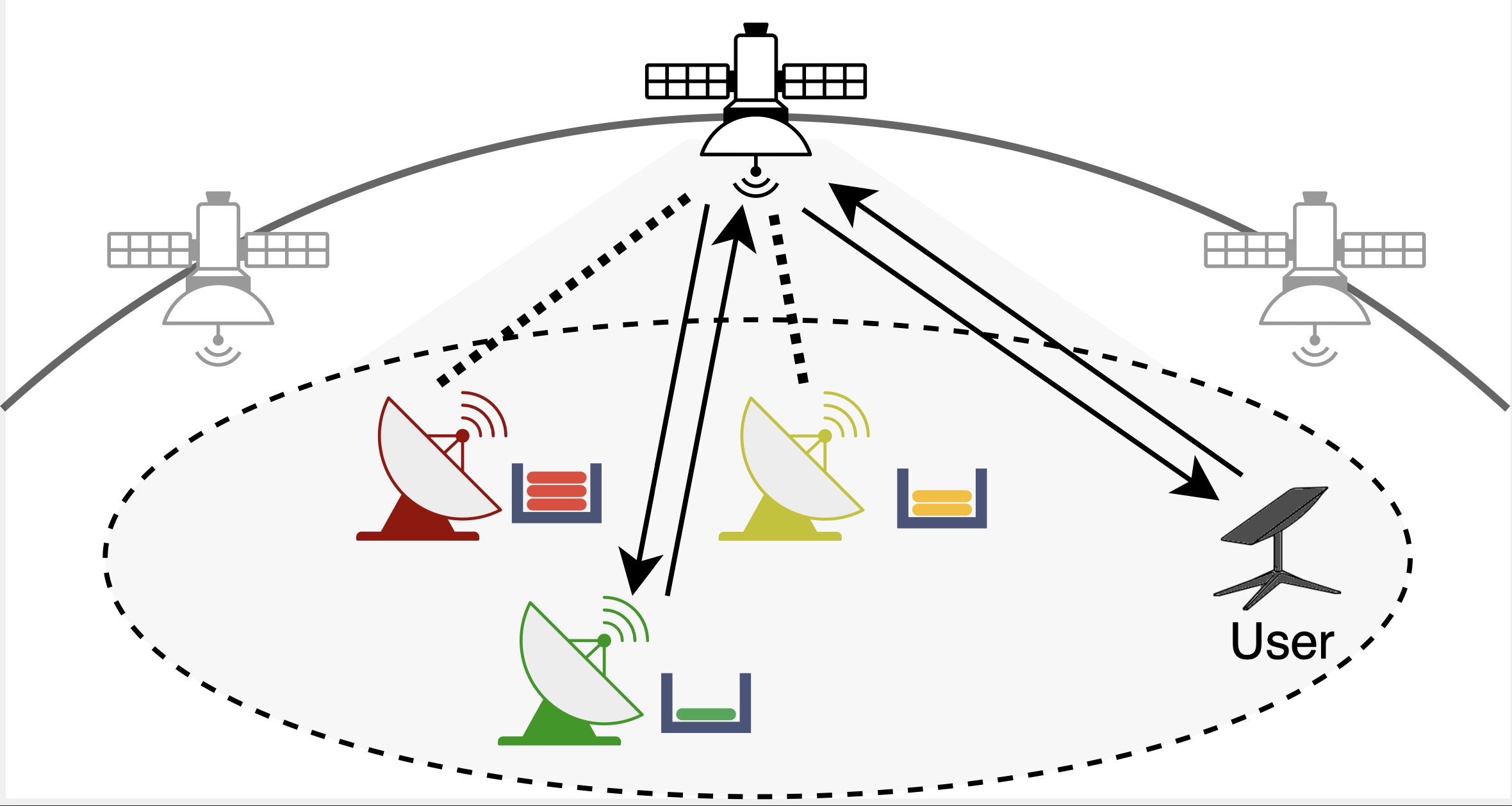
Starlink throughput architecture overview

To appear in HotNets 2026

What Goes Around Comes Around: Predictive Ground Station Selection For LEO Constellation
Fan-Xue Gabriella Reidys, Mubashir Anwar, Ragini Gupta, Aryan Taneja, Deepak Vasisht, Matthew Caesar.

Read summary

LEO satellite networks have grown into critical communications infrastructure serving rapidly growing volumes of Internet traffic. As demand grows, selecting which ground station each satellite should use becomes a key traffic engineering problem. Existing systems make this decision using present-time conditions: each satellite selects the best ground station currently in view, which remains fixed throughout the connection window. However, the traffic served by a satellite can change substantially during that interval, causing individually reasonable decisions to collectively overload heavily demanded ground stations while available capacity elsewhere remains underutilized. To address this, we present INSITE, a predictive ground station selection framework that jointly plans constellation-wide assignments using predicted traffic demand over each connection window. In doing so, INSITE balances load across ground stations, minimizes ISL usage, and reduces congestion-induced queueing. In preliminary results, INSITE reduces the load imbalance factor by 51%, the overflow traffic that would otherwise be forced onto detours to distant stations by 70%, and packet loss under application latency budgets by 3×.
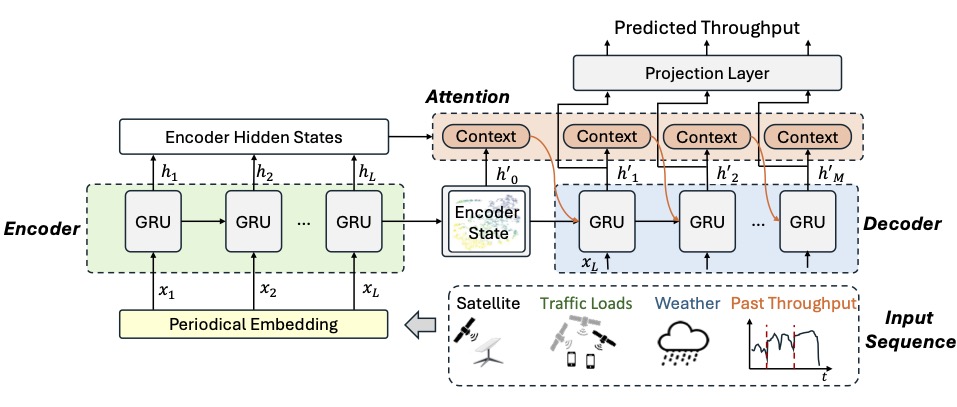
Starlink throughput architecture overview

CoNEXT 2025

Vivisecting Starlink Throughput: Measurement and Prediction
Zikun Liu, Fan-Xue Gabriella Reidys, Sarah Tanveer, Deepak Vasisht.

Read summary

Internet connectivity using low earth orbit (LEO) satellites is gaining significant traction, with nearly 3 million users worldwide. While these networks promise to provide universal broadband connectivity, they suffer from large throughput fluctuations over short time scales. We conduct an extensive evaluation of Starlink's throughput across three devices in different countries, with measurement durations ranging from one to six months. We identify various factors that cause throughput variations at varying timescales. Given our analysis, we design StarNet, a new learning-based throughput prediction system. StarNet incorporates satellite network-specific insights and accurately predicts future throughput for end users. We demonstrate that StarNet's accurate predictions can improve the experience of end user applications like video streaming.

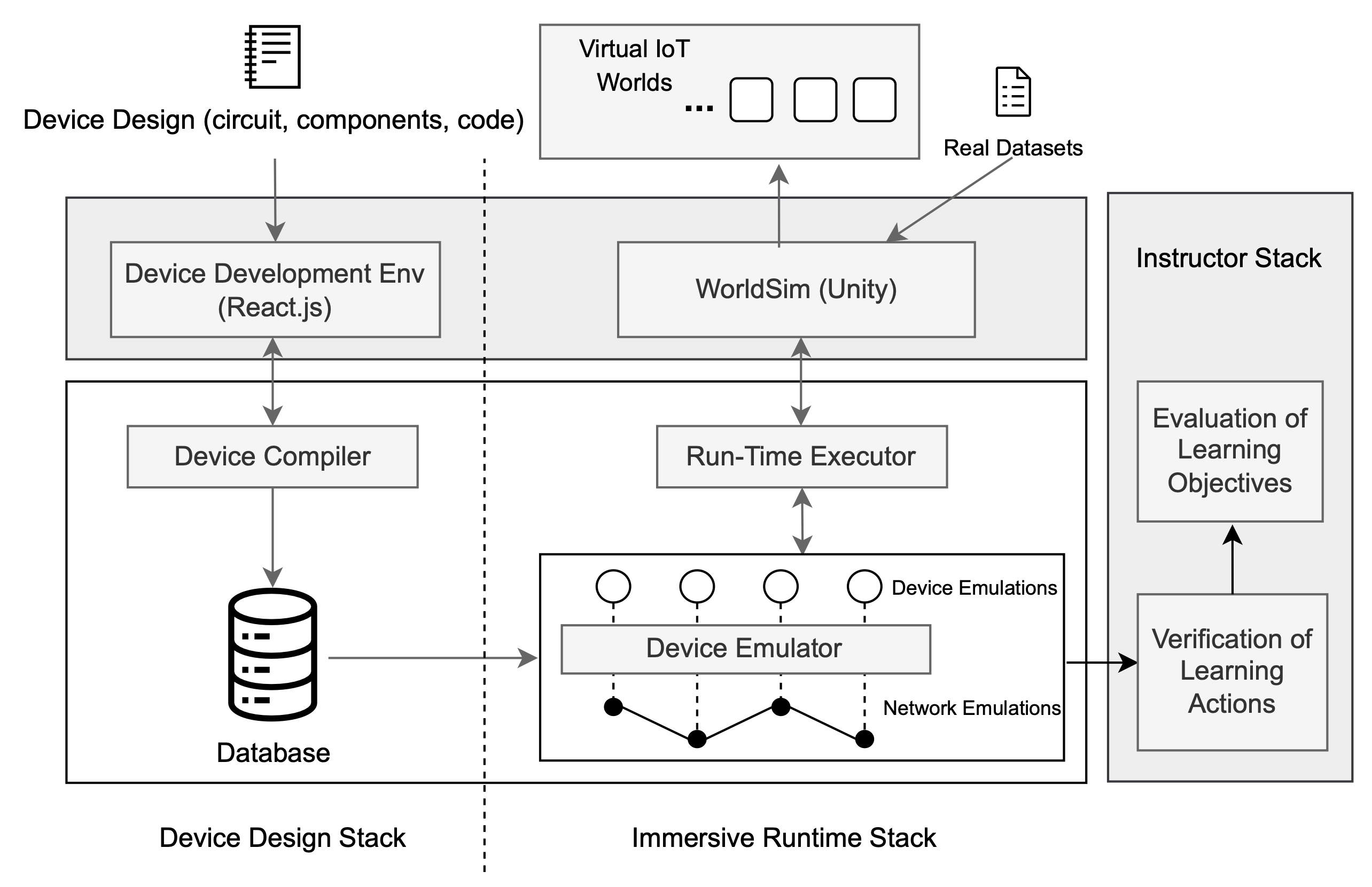
ThingVisor system architecture overview

ACM SIGCOMM CCR 2024

Towards Immersive Cloud-based IoT Education
Fan Gabriella Xue, Matthew Caesar.

Read summary

An increasing number of students are becoming interested in learning about the Internet of Things (IoT) space. However, today, we lack scalable and efficient ways to bring hands-on IoT learning to many due to hardware accessibility, system complexity, and deployment environment constraints. This paper presents ThingVisor, an IoT learning platform that enables hands-on IoT development in an immersive virtual space. Specifically, it allows users to design, test, and deploy IoT devices virtually in a simulated IoT world with static and dynamic software verification as a complementary tool to IoT education. ThingVisor consists of (1) a Device Design Stack to configure virtual IoT devices, (2) an Immersive Runtime Stack to interact with devices and environment, and (3) a Device Emulator, which is a runtime environment used to execute virtual devices to get their behaviors. Our experiments confirm the learning effectiveness and user satisfaction of our platform. Additionally, we have demonstrated the scalability and usability of the system through load testing and application of the System Usability Scale. Our results indicate that students can achieve up to a 32% improvement in their scores after engaging with ThingVisor for two weeks, irrespective of their prior experience.

Activities

  • Accelerated Learning and Engineering Research Training Program Mentor SU & FA 2023
  • Usenix Student Grant Receipiant 2022 OSDI
  • Yunni and Maxine Pao Memorial Scholarship 2021-2022
  • Student Volunteer in Sigcomm 2021
  • ​2021 ​Fall SoS Quarterly Lablet Meeting Student Contributor